

On April 28, 2025, the federal election results signaled a sharp defeat for the labour-based, but pro-capitalist New Democratic Party. After two years-plus in a class collaborationist “supply and confidence” pact with Justin Trudeau’s Liberals, the party had won a privately operated, very limited, income-tested dental program, and subsidized birth control and insulin medications. In exchange, the 24 NDP members of Parliament voted to support Trudeau’s budgets, which included major increases in military spending, huge subsidies for oil and gas billionaires, Trudeau’s strike breaking measures, and more.
Faced with polls showing Pollievre’s anti-labour Conservatives in the lead as the election campaign commenced, and an NDP offering no working-class agenda, many workers, including traditional NDP supporters, plumped for Trudeau as a “lesser evil”. Socialists understand that ‘lesser evil’ politics is a trap; it was time to hold our nose and vote for the labour-based NDP.
NDP leader Jagmeet Singh resigned on election night. That set in motion a leadership race. Soon there were 6 candidates. Yves Engler, author, anti-imperialist campaigner and socialist, Avi Lewis, a former NDP candidate, a left social democrat, and a scion of the Lewis family of long time NDP leaders, Heather McPherson, an MP from Edmonton and a right-wing social democrat, Rob Ashton, President of the International Longshore Workers Union, Tenille Johnson, an Indigenous municipal councillor from Vancouver Island, and Tony McQuail, a holistic farmer from Ontario.
The rules obliged the candidates to give the party $100,000 plus 25 per cent of all additional funds raised after vetting by a 3-person committee. The appointed committee’s approval was based on vague criteria and a totally opaque process.
The vetting committee, chaired by National Director and supremely autocratic Lucy Watson, rejected the application of Yves Engler on subjective grounds, including the allegation that Yves is ‘too aggressive.’ Yves had a reputation for video recording cabinet ministers as he bid them answer questions about their anti-labour policies and actions, their backing of US wars and their support for more oil and gas pipelines.
In actuality, they opposed Yves because he is a socialist, an outright anti-capitalist and an outspoken advocate of a program that would solve real problems at the expense of capitalism and the profit system. The current NDP leadership sees the capitalist state as a neutral machine that needs only some minor adjustments. The party brass defends capitalism against socialism. By so doing, they betray the interests of the working class. Sadly, there was no opportunity for an independent appeal, no way to defend Yves’ program, in effect, no democracy.
Bianca Mugyenyi, Yves’ partner and campaign co-manager, then applied to be a leadership contestant. She is a powerful, independent-minded socialist in her own right -- the first black woman to seek the position since Rosemary Brown in 1975. Bianca was rejected on the racist and sexist basis that she was merely a pawn, a proxy of Yves. It was then crystal clear that no genuine socialist would be allowed to run.
The campaigns waged for Yves, and then Bianca, disclosed broad support for a socialist NDP leader. The initial $100,000 registration fee was easily raised. When Bianca applied to run, another $100,000 was quickly pledged. Well over 1,000 volunteers signed up. Veteran socialists rejuvenated by the campaign, and hundreds of young people from outside the NDP, from the fight against climate change, campaigns for LGBTQ+ rights, opposition to imperialist wars and for Indigenous rights stepped forward. They reflected the opportunity that the NDP could and should turn sharply to the left and inspire young people across the country.
Yves traveled across Canada. He spoke at meetings from the Atlantic region to Vancouver Island. Like socialist organizers of old, he often traveled by bus or train instead of more expensive air travel; he stayed in the homes of supporters rather than in comfortable hotel rooms, and he found enthusiastic supporters everywhere. Leaflets and campaign buttons proliferated. Social media was quickly engaged. It was inspiring for everyone involved.
Perhaps one of the most inspiring aspects was the project to develop a political program. The campaign issued an open call to all, inviting anyone who wanted to participate in the creation of a socialist program. At the first Zoom policy committee meeting 48 people showed up. These people volunteered for a variety of topic areas and went to work. The project was coordinated by Mark Lister, a union member in Vancouver and Socialist Action organizer, and Jasmine Peardon, a graduate student in Montreal. Working at high speed, this group created a 47-page socialist program in English, 48 pages in French, unanimously adopted. It is rare to see such unity among socialists who come together from disparate backgrounds, experiences and traditions.
The program is titled “Capitalism Can’t be Fixed. Onward to a Socialist Future”. It asserts that big capitalists hold the economic power and control the state which is created entirely to operate in their class interest. It demands the replacement of the capitalist state by a state where workers and the oppressed democratically control the economy in their own interest. It calls for the confiscation of the property of the rich and its deployment under collective ownership. It calls for the dissolution of the capitalist police, military, prisons, courts, spies and indoctrination institutions. It omits only the axiom that socialism cannot be won without the willingness, the capacity, and the structure to confront inevitable capitalist violence, towards the establishment of workers’ power by confronting such ruling class violence.
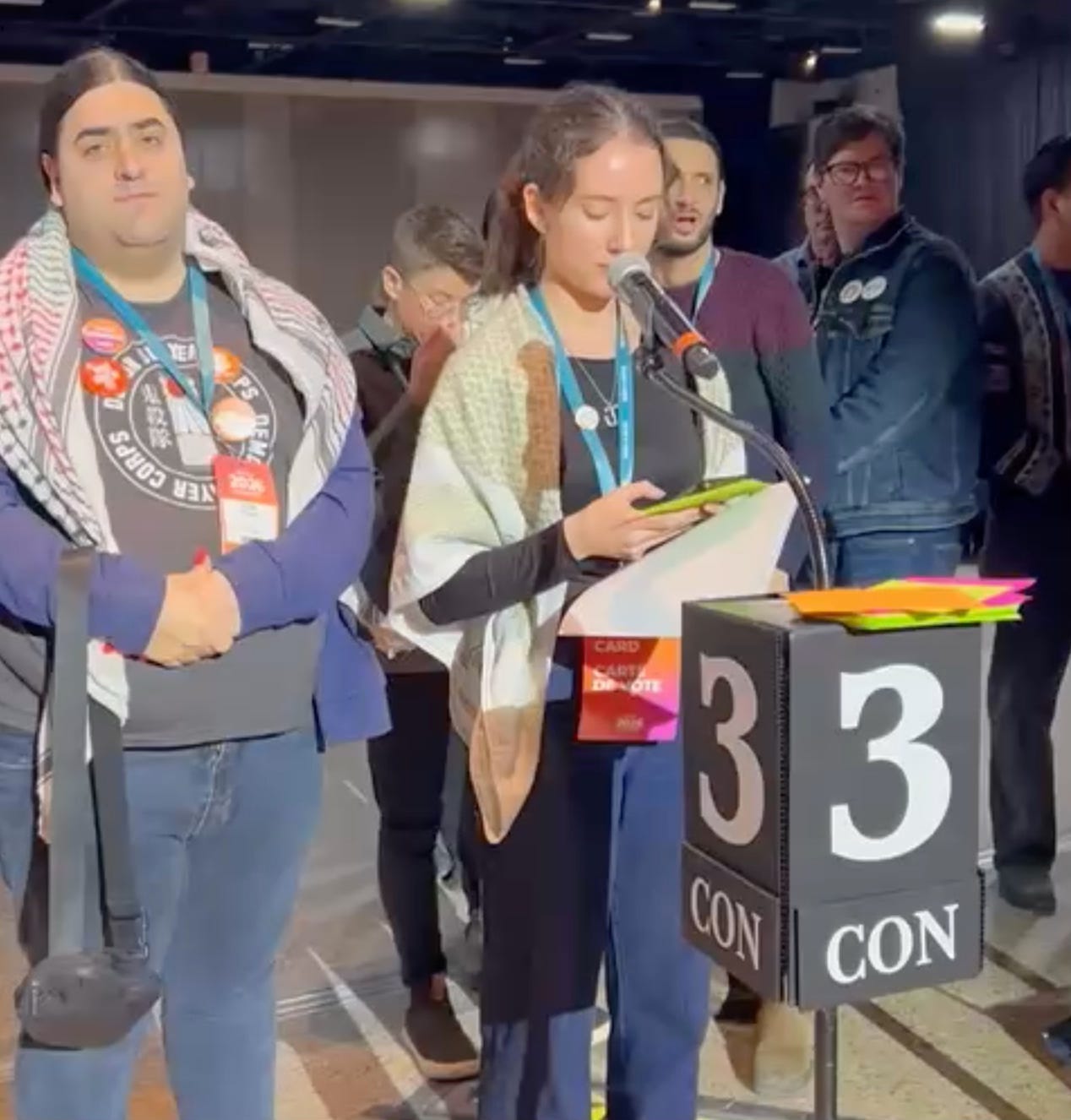
The NDP federal convention, held in Winnipeg at the end of March, was attended by over 1700 delegates. The gathering was a reflection of Canadian society, incorporating labour and virtually all oppressed sectors of the population. It has become a norm in the NDP for conventions to severely limit discussion on the record of the leadership, the disastrous financial situation, or the tepid and limited policies of the party which offer no fundamental solutions to the growing inequality of wealth, the increasing repressive measures against democratic protest, the increasing allocation of wealth away from basic needs towards war and destruction. In that respect, nothing changed. The Socialist Caucus and Yves Engler supporters were denied even a literature table. Barry Weisleder, chair of the Socialist Caucus, was denied a credential and banned from the convention hall. Lucy Watson had notified Yves Engler before the convention that he had been expelled from membership in the NDP. None of these actions were discussed openly in the official decision-making bodies of the party. They were implemented by fiat from the autocratic, pro-capitalist bureaucrats led by Lucy Watson.
But socialists are very difficult to repress. A literature display was set up to operate out of a suitcase. Huge numbers of socialist leaflets and pamphlets were distributed and sold. Over $900 of literature, buttons and T shirts was sold; over 100 names were added to socialist supporter lists. Two well organized evening parties, featuring professional musicians and singers, were organized by the socialist forces.
The leadership election resulted in a first ballot decisive win by Avi Lewis with 56% of the vote. A slate of Lewis supporters also took control of the party executive. The Lewis campaign put forward a left social democratic populist program. If Lewis wants to lead the party to the left, as he advocated during his campaign, he will need to staff the party with supporters, beginning with the termination of Lucy Watson. The Lewis campaign brought a lot of radicalizing young people into the party, attracted by his left social democratic program. Even to carry forward his reformist program, Lewis will face stiff headwinds. Most of the small parliamentary caucus did not support him. Although he advocates a fair transition for labour towards a sustainable energy system, conservative labour bureaucrats such as those in the steel workers union and some construction trades will oppose him. The Leaders of the pro-oil Alberta and Saskatchewan NDP sections, have already voiced their opposition to his more aggressive climate program.
Despite Lewis’s workers’ rights platform, he secured fewer endorsements from unions, central labour bodies and union leaders than Rob Ashton, the president of the International Longshore and Warehouse Union (ILWU) Canada.
Unions endorsing Ashton included the Canadian Union of Public Employees (CUPE) British Columbia, CUPE Saskatchewan, the United Food and Commercial Workers (UFCW) Canada, the Service Employees International Union (SEIU) Local 2, as well as many local labour councils. Several prominent labour leaders also backed Ashton, including the president of the Canadian Labour Congress (CLC), Bea Bruske, and Marty Warren, the national director of the United Steelworkers (USW) Canada.
This level of official labour support was somewhat predictable given Ashton’s prominent place in the Canadian labour movement, particularly in British Columbia. Yet when the votes were tallied, Ashton finished fourth, pulling in only 4,193 votes (5.9 per cent).
As Brock University Labour Studies professor Larry Savage pointed out, unions endorsing Ashton collectively represent 659,200 workers. This means that fewer than 0.6 per cent of members from these endorsing unions joined the NDP and voted for Ashton.
As Savage continued, “The result is a striking reminder that endorsements don’t always translate into votes. Given that organizing and mobilizing are the lifeblood of the union movement, this result is a disaster and tells us a lot about the institutional weakness of unions inside the NDP.”
The result also suggests, however, that many unions did not recognize the growing appetite for change among their own members.
It wasn’t only Ashton’s defeat that revealed labour’s disconnect from NDP members. The Party’s executive, including incumbent treasurer Susanne Skidmore, the sitting president of the B.C. Federation of Labour, was also voted out in favour of the Lewis-aligned “Change, together” slate of candidates.
Thomas Mulcair, a former Liberal Party of Quebec cabinet minister was Federal NDP leader after the death of Jack Layton. With Lucy Watson as his National Campaign Coordinator, he engineered the disastrous 2015 federal election campaign. Despite early polls indicating the NDP would form the federal government, the NDP only won 44 seats. Why? Because Mulcair, ever the responsible capitalist politician, said he would not run a budgetary deficit, proposing instead a policy of higher taxes and cuts to social programs. Capitalist politician Justin Trudeau promised not to do that; he easily defeated Mulcair.
At the subsequent NDP federal convention in Edmonton, Mulcair lost a confidence motion by failing to win a majority of delegates. Since then he has assigned substantial blame to Avi Lewis. He now attacks Lewis as a mainstream political commentator claiming Lewis isn’t sufficiently pragmatic to win an election. He means that Lewis, in his view, isn’t opportunistic enough, and not close enough to the capitalist chattering classes. Of course the Globe and Mail and the National Post will tell Canadian workers repeatedly not to vote for the “extremist” Avi Lewis.
With delegates streaming out of the hall, rushing home at the close of the convention, 46 socialists attended an impromptu evaluation session. They concluded that socialists had two key tasks in the next period. Defend Lewis from the slanders of the capitalist press and rants such as from former NDP leader Thomas Mulcaire, and past leader candidate Brian Topp. Socialists resolved to push Lewis to keep his campaign promises and urge him to move further left. Secondly, to address the increasing numbers of radicalizing Canadians by openly organizing a new socialist movement independent of the NDP which can educate, agitate and organize wherever Canadian workers and oppressed take up the fight against their exploiters and oppressors. Socialists cannot allow the NDP brass to stifle the fight for socialism. The lessons of working-class struggle must be shared with anyone willing to listen, both inside and outside the NDP.
On Sunday, May 24, a hybrid in-person and on-line conference will occur in Toronto. Militants drawn together by the Yves Engler NDP leadership campaign will consider how best to bring together socialists across Canada. The goal is to regroup the increasing numbers of activists in unions and organizations of the oppressed groups into a united socialist movement. A new and growing movement capable of participating in anti-capitalist action and education can move further toward a mass socialist formation with ever deepening roots across the country.
Bringing "together socialists across Canada" is the right move, even though the devil may be in the details. How large should the net be? How to be inclusive and yet principled? What is the lowest common denominator for an optimum tent, i,e,, one that includes the greatest number of organizations, groups and people, without losing any, and yet grounded in the principles of social justice and common good, with the well-being of many generations in heart? Not an easy task, but not impossible either. In solidarity.