

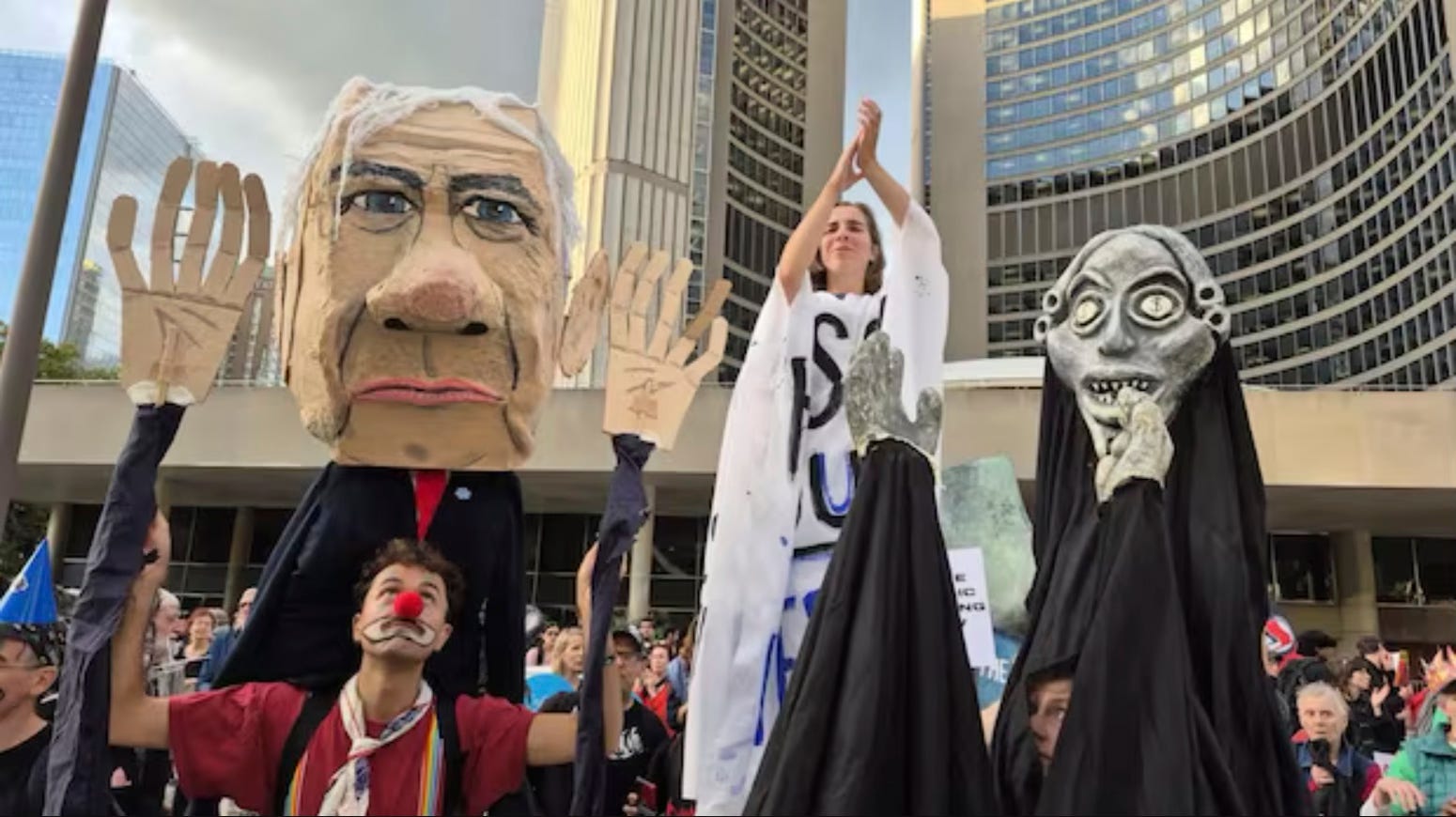
Months of organizing brought movements together and carried an unapologetically anti-capitalist message across the country
The September 14 demonstration against Mark Carney’s CEO summit was a big boost for the Left. Some 2,000 people participated in the Confront Carney’s CEO Summit protest in Toronto, which included a “Carnival Against Capitalism” targeting the largest gathering of capitalists in Canadian history.
The biggest explicitly anti-capitalist protest in Canada in many years received widespread mainstream media coverage. CBC’s The National went live to the march at the top of its broadcast that night, while international outlets including Reuters, Al Jazeera and the New York Times reported on the protest.
The carnival also made the protest unusually visually compelling. Costumes, giant puppets, a marching band, stilt walkers, handmade signs and street theatre meant images from the demonstration were splashed across social media, websites and television. While the far right Rebel News predictably mocked the protest in “Anti-Capitalist Mob Descends on Carney’s Canada Investment Summit”, some of the corporate coverage was quite sympathetic. City News, for instance, did a terrific three-minute clip on protesters’ opposition to a wealth-concentrating, ecocidal economic system Carney’s CEO summit was designed to entrench.
The idea of organizing a Carnival Against Capitalism to protest Carney’s CEO Summit was first raised at the founding conference of Capitalism Can’t Be Fixed (CCBF) in May. As is usually the case with a successful demonstration, the mobilization leading up to the march was a central part of the political action. The aim was to expose Carney as an agent of the global rich and organize opposition to an agenda transferring wealth and power to the billionaire class.
Over the following months, CCBF released a widely endorsed public letter to “Confront Carney’s CEO Summit” and published articles, memes and videos about Carney’s agenda. Organizers held webinars, built art and digital teams and reached out to activists and organizations across Toronto and beyond.
On the ground, Toronto activists put up more than 12,000 “Confront Carney’s CEO Summit” stickers and 2,500 posters advertising the Carnival Against Capitalism. Thousands of informational leaflets were distributed. Artists and volunteers produced puppets, props, placards and costumes that would eventually fill the streets.
By pushing forward with a demonstration before it was clear how much public interest or institutional support it would attract, CCBF created a platform for a wide range of groups to express their rage at Carney’s militarist, pro-billionaire agenda. As momentum grew, the mobilization became a vehicle for a much broader convergence of organizations and movements. The Many vs. the Money coalition, led by the Council of Canadians, World BEYOND War and 8th Fire Rising, organized a weekend counter-summit, and joined the effort to help broaden institutional participation. Ultimately, the Carnival Against Capitalism march included contingents from the Revolutionary Communist Party, Acorn, Unifor, Socialist Action, Greenpeace, 350 and dozens of other organizations.
8th Fire Rising facilitated Indigenous leaders to come to Toronto to challenge Carney’s policies. Hereditary Chief Na’Moks, Kanahus Manuel and Kakeká ThunderSky spoke at the rally and joined the Indigenous contingent that led the spirited march from Nathan Phillips Square to the Art Gallery of Ontario, where Carney was hosting the CEOs.
Despite a heavy police presence on foot and horseback, the march reached the AGO and made itself heard outside the summit. Several attendees had to walk past protesters as they left the gala dinner.
What Carney announced at the summit the following morning underscored the political stakes of the protest.
The government announced plans to effectively privatize the operation of Canada’s four largest airports through long-term concessions to private investors, while retaining public ownership of the underlying land and assets. In response, Capitalism Can’t Be Fixed coordinator Jasmine Peardon stated: “Selling off public assets is part of Carney’s pro-billionaire agenda that thousands protested Monday. He’s doubling down on the same economic policies that got us here in the first place– but more of the same will only deepen the crisis.”
Carney’s other big announcement at the summit was a massive new corporate tax incentive. The Prime Minister announced a “Productivity Mega Deduction” that the government estimates will cost $36 billion over the next five years and slash the marginal effective tax rate on new business investment from 13 per cent to 6.4 per cent. Carney boasted to the billionaire crowd that Canada would now have the lowest rate in the G7 — and he wasn’t lying. Canada’s rate will be well below the U.S. rate of 16.9 per cent and the OECD average of 19 per cent.
Even before the summit, Carney’s government had introduced several measures to lower the tax burden on corporations and encourage private investment. It created the Productivity Super-Deduction and expanded the Scientific Research and Experimental Development (SR&ED) tax incentive. Even more significantly, Carney cancelled a planned increase in the capital gains inclusion rate and scrapped the digital services tax.
Changes to the tax code are but one of many pro-corporate measures Carney’s government has pursued.
For protesters outside the summit, the announcements reinforced the central argument of the mobilization: that the former Goldman Sachs banker is reorganizing Canadian economic policy around the interests and demands of capital.
Even the National Post recognized the significance of the convergence. In a column headlined “The left is itching for class warfare,” Tasha Kheiriddin began “for a movement supposedly wandering the political wilderness, the Canadian left made a lot of noise in downtown Toronto Monday night. Hundreds of protesters gathered at Nathan Phillips Square before marching to the Art Gallery of Ontario, where Prime Minister Mark Carney was hosting some of the world’s wealthiest investors. The demonstration reunited an old-school coalition of labour unions, Indigenous activists, environmentalists, housing advocates and anti-war groups.”
The demonstration showed that there is an audience for an unapologetic challenge to concentrated wealth and corporate power — and an appetite for collective action across movements and political traditions.
It also demonstrated the importance of organizing before the outcome is certain. What began in May as an ambitious proposal grew through months of postering, leafleting, art-making, media work, outreach and coalition building into something far larger than any one organization.
The September 14 demonstration was the visible result: thousands in the streets, an anti-capitalist message carried across the country, and movements that do not always work together marching side by side.
If we want to challenge Mark Carney’s ecocidal, wealth concentrating agenda we need to build up a fighting socialist movement.
Substack has so many hidden trapdoors, such as yours requiring verification before I post.
However I would like to make reply on my timeline and not through a forced top-down timeline.
However the trapdoor seemed not to work if and when on other sites, thank yours here with the trapdoor, I come back at a time of my choosing.
Bianca, Suggestions?