

Canada has long positioned itself internationally as a rights-respecting democracy, its Charter of Rights and Freedoms guaranteeing expression, peaceful assembly, association, and — through judicial interpretation — the right to strike. But over the past two years, a pattern has emerged across federal, provincial, and municipal governments: a steady tightening of the legal space in which Canadians can protest, speak, organize, and withhold their labour. Despite some push back from the courts, the legislative and enforcement direction points toward contraction rather than expansion of these freedoms.
Canadians who protest Zionist violence, starvation and murder of Palestinians face a constant drumbeat of police harassment, arrests and legal hassles in continuing reaction to the slightest complaint by Zionist provocateurs. Zionists, however, violate Canada’s laws by recruiting Canadians to join Israel’s army and participate in the disgusting genocide against Palestinians as part of a foreign military. In addition Zionists persistently organize fake charities so that rich donors get tax deductions for their support of the Israeli state. But response to these illegal acts is minimal and slow.
The Legal Architecture behind the Squeeze
Section 2 of the Charter protects freedom of expression, peaceful assembly, and association. Crucially, though, all Charter rights are qualified by Section 1, which allows government to impose limits that are “demonstrably justified in a free and democratic society.” Since the Supreme Court’s 1986 ruling in R. v. Oakes, courts have applied a proportionality test: government needs a pressing objective, and its chosen means must impair the right no more than necessary. This means Canadian rights have never functioned as absolutes. As governments increasingly invoke rationales for public safety, national security, and anti-hate, the room to justify restrictions expands similarly. Critics argue this is precisely what’s happening now: legitimate-sounding objectives are being used to include broad categories of peaceful, lawful activity.
Assembly and Protest: A Patchwork of New Restrictions
The clearest evidence of contraction of freedom is at the municipal and provincial level. Since 2024, waves of Ontario municipalities have adopted so-called “bubble zone” bylaws that restrict protest activity near designated gathering spaces. Vaughan’s version, currently being challenged in court by the Canadian Civil Liberties Association (CCLA), can impose fines as high as $100,000 on people found to have participated in a protest deemed offensive or disruptive to nearby institutions — a standard that civil liberties advocates say is dangerously subjective. Winnipeg has floated a similar anti-protest bylaw, and in early 2026 Ontario’s premier sought a court injunction to block the long-running annual Al Quds rally in Toronto.
Quebec has moved further still. Bill 9 and Bill 13, both advancing through the National Assembly, have drawn condemnation from the CCLA and the Ligue des droits et libertés, who argue the legislation unjustifiably curtails expression, assembly, and association under the banner of public safety and secularism. More than 220 civil society groups signed on to warnings about Bill 13 specifically.
At the federal level, Bill C-9 — officially “An Act to amend the Criminal Code (hate propaganda, hate crime and access to religious or cultural places),” introduced in September 2025 — has become the most contested piece of legislation in this space. The bill creates a new offence for publicly displaying symbols associated with listed terrorist entities and expands protections around religious and cultural sites by criminalizing intimidation and obstruction near them. The CCLA and more than three dozen other organizations warn that the bill’s vague thresholds — particularly around hate symbol display and the government’s discretion over which groups are “listed entities” — could sweep in demonstrators who never intended to incite hatred. Specific concern has centred on solidarity protests connected to the Israeli-Palestinian conflict, including demonstrations outside synagogues and community centres hosting events unrelated to worship, which critics say could now trigger criminal liability regardless of protesters’ actual intent. The bill was pushed through committee on an accelerated timeline in early 2026, with critics arguing that the abbreviated process weakened, rather than improved, its safeguards.
There have been judicial checks on this trend, however. In a case with major implications for protest rights, the Federal Court ruled in January 2024 — and the Federal Court of Appeal upheld in January 2026 — that the 2022 invocation of the Emergencies Act against the “Freedom Convoy” blockades was unlawful and unconstitutional. The appellate court specifically warned that treating infrastructure blockades as national-security emergencies risked chilling a wide range of legitimate protest activity, from pipeline demonstrations to rail blockades. That ruling stands as a counterweight to the broader legislative trend, showing courts remain willing to check executive overreach even when it targets disruptive rather than peaceful protest.
The Right to Strike: Protected in Principle, Constrained in Practice
Labour rights present a more genuinely mixed picture. Since the Supreme Court’s landmark 2015 decision in Saskatchewan Federation of Labour v. Saskatchewan, the right to strike has been recognized as constitutionally protected under Section 2(d) of the Charter, as an essential component of meaningful collective bargaining. That principle has been reaffirmed and, in some instances, strengthened: an Ontario Superior Court judge ruled that legislation barring Toronto Transit Commission workers from striking was unconstitutional, finding the government had failed to prove transit service met the legal threshold of an “essential service” whose disruption would endanger public health or safety.
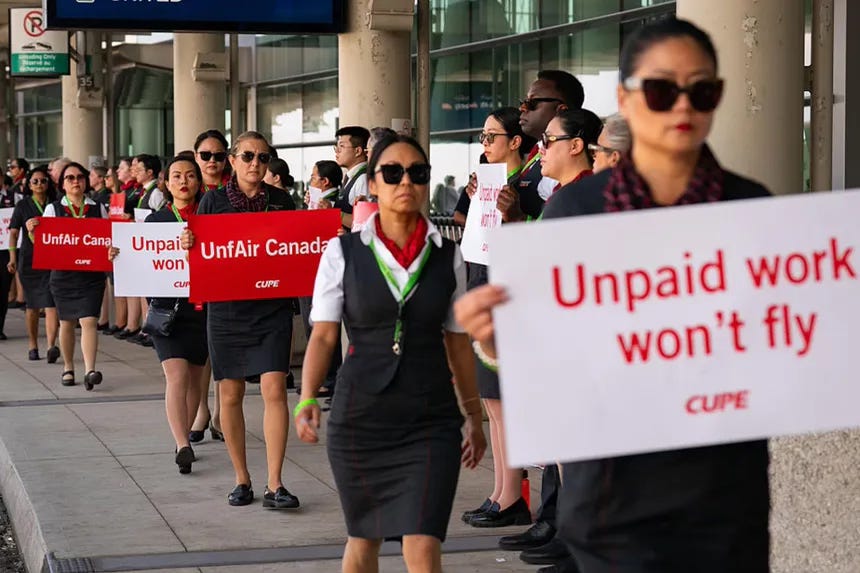
Yet government intervention in strikes has continued and, arguably, intensified. Canada Post workers have faced repeated federal intervention across recent labour disputes — including a December 2024 order under Section 107 of the Canada Labour Code directing the Canada Industrial Relations Board (CIRB) to end a strike and impose arbitration. The postal workers’ union challenged that order as unconstitutional; the CIRB rejected the challenge, concluding the right to strike, while “essential,” is “not absolute,” and that Section 107 did not violate the Charter. A separate, closely watched Ontario Court of Appeal decision in February 2026 examined the 2018 back-to-work legislation that ended a Canada Post strike, ruling that while such legislation does infringe workers’ associational rights, it can be justified under Section 1 when paired with a genuinely neutral, fair arbitration process that approximates what free bargaining would have produced. In effect, the courts have created a functional workaround: governments can still end strikes by legislative fiat, provided they substitute a credible arbitration mechanism.
In May 2026, the International Court of Justice issued an advisory opinion confirming that International Labour Organization Convention No. 87 protects a right to strike — a decision with potential implications for the 158 signatory countries, including Canada — though the court deliberately avoided defining the precise scope or permissible limits of that right, leaving the matter for the ILO’s Governing Body to revisit later in 2026.
On September 21, 2026, the Carney government tabled an omnibus Bill C-39 “Building Canada Strong Act”, which will amend several pieces of legislation that could delay priority projects. The bill amends the Canada Labour Code to expand the use of the problematic Section 107, despite Labour groups calling for its elimination. Unions have expressed outrage, saying these amendments violate workers’ constitutional right to withdraw their labour and entrench government interference in labour disputes.
A Pattern, Not a Uniform Crackdown
What emerges is not a simple story of authoritarian drift, but a genuine tightening across multiple, overlapping fronts. Municipalities are restricting where protest can occur; provinces are passing broader public-order and secularism legislation; the federal government is expanding criminal liability around hate symbols and religious sites; and labour boards continue to bless government intervention in strikes provided procedural substitutes are offered. Countervailing court decisions — on the Emergencies Act, on TTC strikes, on back-to-work legislation’s constitutional limits — demonstrate that Canada’s judiciary remains an active check on these trends, not a rubber stamp. But the direction of travel, driven by legislatures rather than courts, points toward a narrower, more conditional understanding of speech, assembly, and strike rights than existed even five years ago.