

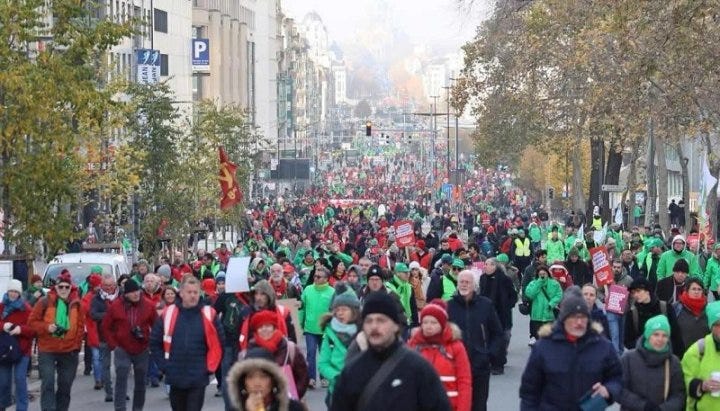
Over the past month, Europe has joined France in the streets. Strikes and demonstrations have broken out in Portugal, Spain, Italy, the UK, Belgium, Germany, the Czech Republic, Greece, Albania, Serbia, Poland and Finland. In France the spark came from the youth: high school and junior high school students walked out of classes, set up barricades in front of their schools and demonstrated in the streets, with or without official authorization. The degradation of school buildings and the non-replacement of teachers on sick leave are symptomatic of the state of public services in general. The high cost of living and the demand for across the board salary increases is also a major factor which put the unions on the streets next to the youth. Elsewhere in Europe the housing crisis, the anti-war movement and the struggle against corruption are also factors which have contributed to mass mobilizations. The high cost of fuel due to the blockage of the Hormuz Strait alongside Iran was the straw that broke the camel’s back. Trump and Netanyahu are not the only culprits as decades of neo-liberal policies on the Old Continent have pushed Europeans to revolt.
After the first big marches organized by French students on October 17 (800,000), October 19 (250,000), October 24 (800,000) demonstrators, the trade-union federations put over a million and a half workers on the streets in a first one-day general strike on November 5 and again on November 17 with 500,000 workers and their allies demonstrating throughout the country.
Since the outbreak of the revolt the Prime Minister waited almost a month before convening a meeting of union leaders in his office on November 13, officially to work out a compromise. The government clearly doesn’t get the message but the working class and the young are not letting President Emmanuel Macron off the hook.
Fifteen percent of the population now lives beneath the poverty level. Two million, one hundred thousand (2,100,000) workers earn the minimum wage and most of them are women. Small companies are not the only ones to blame: the biggest employer in France is the state. Eight hundred and sixty thousand (860,000) civil service workers don’t even earn the minimum wage! The monthly net minimum wage is now €1,478 ($2,320 CAN) -- clearly insufficient to survive given the rising cost of living. If no increase occurs, there will be over a million public sector workers in this category in December, as many public sector jobs are part time. The two most combative union federations are demanding an increase in the minimum wage of €150 and €200 respectively. What did Prime Minister Sébastien Lecornu offer? An increase of €23. That will buy you a 10 kilos bag of potatoes. Or if you have to fill up at the gas station, that will put only 0.2 imperial gallons of fuel in your tank.
The authorities still reply with repression: thousands of supplementary arrests and stiff sentences for often unproven offenses, just to make an example. The Education Ministry tried to prohibit students from demonstrating in front of their schools. But the main high school student union appealed that decision to court… which authorized this form of protest, saying the government’s attempt to curtail the right to demonstrate to that extent was unconstitutional. This gave the youth – and the labour movement – an added boost to maintain their mobilizations.
One-day general strikes aren’t the best strategy to build a relationship of forces and oblige the ruling class to satisfy the demands of the strikers and demonstrators. But the rank and file – as well as the student movement – is keeping up pressure both on the government, on the employers and… on the union brass. Major demonstrations have taken place every week. In the third week, 500,000 marchers were still demonstrating, with another 200,000 two days later (a dress rehearsal for the upcoming general strike). These mobilizations have been going on for five consecutive weeks. In a desperate attempt to discourage the movement, paramilitary police protected fascist militias who attacked demonstrators in Montpellier, Clermont-Ferrand and other cities. And yet, the mobilization is far from dying down.
The austerity measures contained in the governments proposed budget will lower the purchasing power of 22 million households. Those in power still refuse to tax the rich or to tax capital gains as much as they tax labour. And yet in 2025, the CEOs of the 40 biggest companies in France listed on the stock exchange earned an average income of €7.5 million every year (close to $12 million CAN), i.e. 423 times the minimum wage. And those same companies distributed no less than €107 billion euros ($168 billion CAN) in dividends to their shareholders. But the government still proposes a measly raise of €276 ($433 CAN) per year for minimum wage workers.
All of the country’s trade-union federations called for the November 17 general strike across the public service. A number of private sector workers, not to mention the unemployed, the students, seniors on small retirement pensions, and long-time Yellow Jacket activists, also heeded the call to demonstrate. Until the employers and their governments significantly improve purchasing power and public services, workers in France and elsewhere in Europe aren’t ready to bury the axe of the class struggle.