

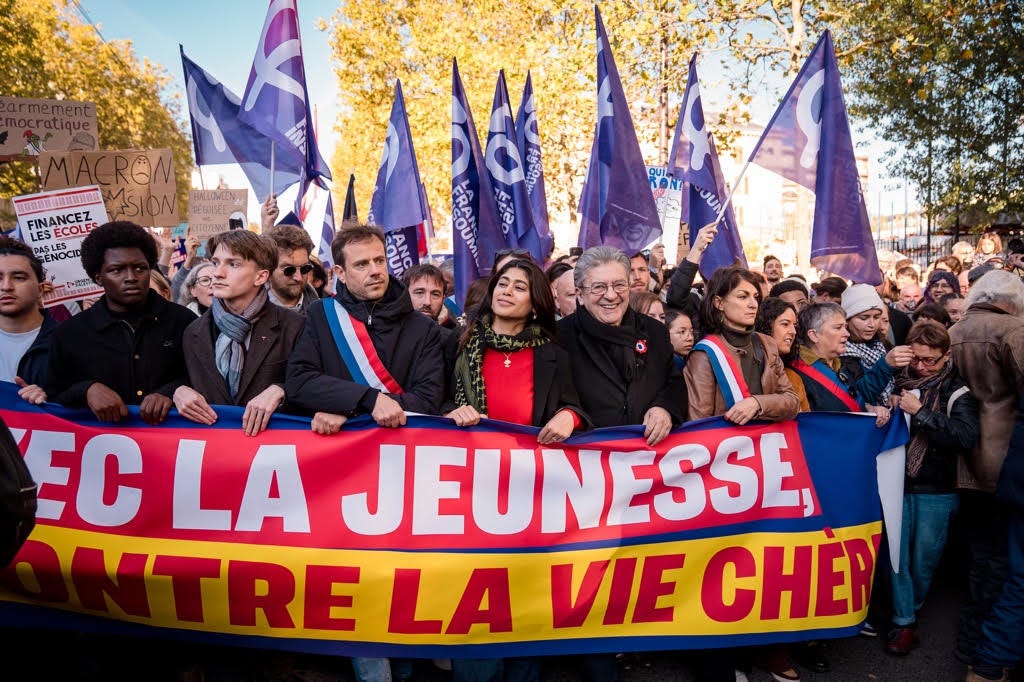
PHOTO CREDIT TO JEAN-LUC MÉLANCHON (SOURCE: FACEBOOK.COM)
On October 17, 24 and 31st well over 1 million demonstrators took to the streets throughout France: in the big cities, the smaller towns and even in the countryside. This is the biggest mobilization since the student revolt and general strike of May 1968.
To paraphrase Marx, a spectre is haunting France - the spectre of the Yellow Jacket mass movement which first rose up against the high cost of fuel taxes in 2018. Motorists from semi-urban and rural regions lacking public transport occupied traffic circles, sparking a mass movement confronting President Macron’s neo-liberal policies. With a massive mobilization throughout France, Macron was eventually obliged to make a number of concessions to the working class. He ended tax increases on fuel, indexed old age pensions to inflation, lowered income taxes for the “middle class” (most workers) and increased the minimum wage. The lesson - only struggle pays!
This year it’s another sector of the population which sparked the current uprising: the youth. Protests started in high schools and junior high schools, many of which require urgent repairs, especially in the context of climate change. Not to mention the lack of substitute teachers. Students in junior high schools and most students in high schools are too young to vote. So the government tends to ignore them.
Barely two weeks after classes resumed on September 1st, student walkouts started in the working class suburbs of Paris and rapidly spread throughout the country. The barricades they erected in front of their schools and the demonstrations they organized in the streets were reinforced by the presence of their parents, concerned about their kids’ future. A good number of these parents suffer from low wages and the same neo-liberal austerity as their children. Along with this parental reinforcement came the participation of teachers and their unions, who reinforced the demands concerning the repairs of public schools and the hiring of more teaching staff. Then came university students in solidarity with their younger bothers and sisters in high school, trade-unionists in different sectors of the economy who are revolted by low wages which don’t catch up to inflation. The considerable rise in fuel prices due to the blockage of the Hormuz Strait (thanks to the war started by Trump and Netanyahu) quickly mobilized affected sectors: taxi drivers, truckers, fishermen, farmers and home care. Then hospital staff joined the protests, demanding better public funding for a severely degraded public hospital system. Other workers from different sectors – both public and private – joined the ranks of demonstrators.
Then the Yellow Jackets re-emerged! When the historic leaders of the 2018 Yellow Jacket movement came out to support the high school students and accompanied them in the streets, the political elite trembled. The entire spectrum of left-wing political leaders and the members of their parties have joined these demonstrations, from the revolutionary far left to La France Insoumise (radical left), the Communist Party and the Ecologists.
French presidential elections will take place in April-May 2027. The entire left (including the helplessly moderate “Socialist” Party) has expressed its support for the demands of youth and workers, both those currently on the job and those who survive on modest retirement pensions. The right-wing parties pay lip service to some of the demonstrators’ concerns, while severely denouncing the “violence” which took place on the occasion of a number of marches. The far right Le Pen’s Rassemblement National doesn’t talk about the protesters’ demands. It only denounces the “violence” (of the demonstrators) and loudly stresses its total support… of the police.
On 17 October, the minister of the Interior announced no less than 110,000 demonstrators in Paris alone. Close to 500,000 demonstrated across the country. After arresting more than 6,000 students over the past two weeks, the police made 2,300 arrests throughout France on 17 October, including 1,800 arrests in the city of Paris alone. There were over 10,000 injuries nation wide on both sides (demonstrators and police). A similar pattern occurred in the other protests.
We assembled in the capital’s emblematic Place de la République for a march that was officially authorized. And yet the police prevented people from leaving the square, soon filled with tens of thousands of demonstrators. They pushed back contingents of marchers who managed to break through police lines and take to the streets. Police forces didn’t hesitate to use their favourite method: repression. Tear gas, deafening grenades, police charges and nightsticks fell upon numerous marchers, including teenagers from the high schools. So instead of one single, disciplined march from one point to another (originally approved by the authorities), the movement metamorphosed into a multitude of unauthorized marches in numerous streets and neighbourhoods, each of which included several thousand demonstrators.
The “Black Blocks” attacked the police and set fire to a number of cars, smashed windows and looted shops. By the evening a number of neighbourhoods looked like battlefields and residents were understandably devastated by the extent of the destructions. These tactics tend to keep people away from marches instead of encouraging them to participate. Most TV channels reported more on the destruction than they did on the demands of the demonstrators. Most “Black Block” participants appear to be unpoliticized youth from poor neighbourhoods who just want to settle accounts with the police, enjoy an adrenalin shoot and loot luxury stops. Clashes between demonstrators and police were far from being limited to Paris. Violence broke out in numerous cities, including Lille, Rennes, Nantes, Bordeaux, Limoges, Bescançon, Lyon, Marseille and Toulouse. In Marseille, more than a thousand looters were reported.
It’s not only the spectre of Yellow Jacket activists, of the youth and of the workers’ movement which is haunting France. It is especially the spectre of a mass movement with the potential of becoming permanent which is now haunting the nights of the ruling class.
President Emmanuel Macron denounced the “looters”, deplored the destructions, supported the police and didn’t announce a single measure to improve conditions in the school system, the public hospitals or elsewhere. He refuses to tax capital gains as much as he taxes labour and he equally refuses to raise individual income tax for the ultra-rich.
The context of this revolt comes in the wake of increasing economic disparities between the social classes. There are over 13,000 millionaires in France that avoid income tax. There are now over 40 billionnaires in France, while a good number of workers who have stable jobs are forced to line up in front of soup kitchens. Numerous residents fear being expelled from their apartments because they got behind in paying the rent. The only thing that has been constantly increasing (aside from inflation) is the gap between the very rich – not even 1% of the population – and the rest of the country. Despite dire needs to revamp essential services, the Prime Minister is now preparing a budget with massive reductions in public spending. This is intolerable for most people and the protests in their multiple forms are not likely to disappear overnight.
In advance of the most recent national demonstrations, the government made a promise…. Not to renovate high schools or increase purchasing power. It promised to increase the number of police forces in the streets. We’re getting ready for new showdowns! All the trade-union federations have called for a general strike on 5 November.