

From a Marxist standpoint, Canada joining the European Union as an “associate member” is not international solidarity or working-class progress. It is a strategic realignment of capitalist elites—a tactical maneuver by Canadian and European ruling classes to manage inter-imperialist rivalries, especially in response to pressure from the United States. In this article we examine the class character of the EU, Canada’s subordinate position within American imperialism, and the specific dynamics of the proposed alliance.
Canada already has a trade agreement with the EU: the Comprehensive and Economic Trade Agreement (CETA). About 95% was implemented in September 2017; the remainder requires approval by all 27 EU members, with 17 having approved and 10 holdouts, including France. CETA eliminates tariffs on 98% of goods and services. Canada already has a good trade deal with Europe. Trade agreements like CETA advance multinational corporations over democratic rights, labor standards, and environmental protections. As predicted in a 2015 Tufts University study, CETA suppresses job growth and lowers labor’s share of national income.
Canada is also part of NATO, an aggressive imperialist alliance formed in 1947 to threaten the Soviet Union and now Russia. NATO has always been an enemy of workers and colonial subjects. It began mobilizing in 1968 against 11 million French workers occupying factories. It invaded and occupied Afghanistan for 20 years, attacked Russian-allied Slavs in Serbia, and orchestrated the overthrow of Libya’s government, murdering Gaddafi and creating anarchy.
The Security Action for Europe (SAFE) Instrument is a €150 billion loan program managed by the European Commission to support and expedite defence procurement by EU member states. It is one pillar of the Readiness 2030 Plan, an €800 billion financial-industrial plan for defence readiness by 2030. Canada’s 2025 agreement under SAFE gives Canadian firms preferential access to defence procurements financed by it. In exchange, Canada contributes to Ukraine’s defence industry commensurate with the value Canadian firms derive. This represents a massive diversion of funds from social programs to war. On October 30, Carney and von der Leyen, and their ministers, signed deals on Canada’s participation in the €90 billion Ukraine Support Loan, for which Canada will contribute €500 million, nearly $780 million; (Canada is already spending more than $25 billion on military, governance and humanitarian support for Ukraine). Additionally they agreed to add a digital trade agreement to the Canada-EU free trade pact; and allow the European Investment Bank to invest in Canadian critical minerals.
The EU is a capitalist club, not a workers’ alliance. Marxist analysis rejects the notion that the EU transcends nationalism or represents progressive internationalism. The EU is a neoliberal and imperialist project designed to serve capital. It functions as a means for free and undistorted competition in the service of predation by large capitalist groups and an imperialist political vision. Its legal and economic structures depoliticize key economic decisions, insulating them from popular intervention to protect capitalist accumulation. The EU was formed partly to manage inter-imperialist rivalry and a potentially unruly working class. Its response to the 2008 financial crisis—imposing devastating austerity on Greece, Spain, and Portugal while protecting German banks—showed whose interests it serves. Its Common Security and Defence Policy operates as a dangerous instrument for war and intervention in the service of imperialism, aligning with NATO from Libya to Ukraine. Crucially, the EU organizes the ruling class, not workers. There are no EU-wide political parties or trade unions with real power. The European Parliament is largely consultative, while real decision-making rests with the Commission and Council, bodies insulated from popular pressure.
Canada is a junior partner in a shifting order. From a Marxist standpoint, Canada is not neutral or progressive. It is a capitalist state whose government advances the interests of capital above broader social interests. Historically, the Canadian capitalist class has evolved toward deep integration with and dependence on American imperialism. Nevertheless, the Canadian bourgeoisie has its own history, interests, and state, and has seldom hesitated to advance its own interests aggressively in negotiations with the US, as Carney is currently doing. The push for closer ties with the EU is a direct response to this pressure. Carney’s Davos speech confirmed the sharpening contradictions within global capitalism and the decline of US imperialist hegemony. He identified a rupture in the post-WWII order, with US imperialism moving away from leadership through international institutions toward unilateral coercion, even against its own allies. His call for “middle powers” to act together—summed up by “if we’re not at the table, we’re on the menu”—is a direct response to US decline. However, this project, aimed primarily at aligning Canadian monopoly capital with European powers, leaves the majority of the world’s countries—the overexploited and underdeveloped victims of imperialism—to continue to be “on the menu.”
Carney’s actions, like deepening EU partnerships and joining European defence procurement are forms of intra-imperialist maneuvering, not a turn toward anti-imperialism. Carney has told the financial elite that Canada will stand as a “soft Western imperialist power—pragmatic, diversified, dependable and open for business—in contrast to a more crudely aggressive U.S. imperialism.” The class nature of this strategy is evident in his domestic agenda: tax cuts for capital gains and business, dismantling regulations that protect workers and the public, subsidizing fossil fuels and AI, and more than tripling the military budget while financing it through the most ambitious austerity drive since the 1990s. His claim that “the world aspires” to Canadian values is hard to stomach for workers facing austerity, Indigenous peoples seeing their rights rolled back, and communities enduring extreme poverty, mass unemployment, a housing crisis, and collapsing public services.
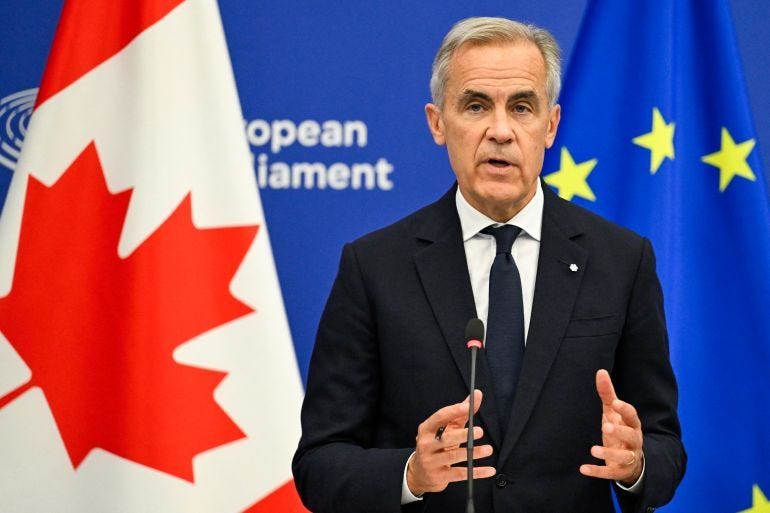
The proposed “associate membership”—a status that does not legally exist yet—is the latest and most ambitious step in building an “alliance of middle powers” to counterbalance the US. Commission President Ursula von der Leyen proposed that Canada become the EU’s first “associate member” during her State of the Union address, with Carney the first foreign head of government to attend. The announcement reflected strengthening political ties between Ottawa and Brussels, driven by shared concerns over US trade policies and strategic uncertainty. The substance reveals its capitalist class character. The concept would allow Canada’s goods, services, and workers in defence, energy, AI, and critical minerals to move freely throughout the 27 EU states. Canada’s vast reserves of energy and critical minerals could help Europe tackle rising energy prices and reduce dependence on hostile actors. Germany secured a 20-year supply agreement for Canadian LNG in May 2026. Discussions have also covered trans-Atlantic subsea communications and energy corridors, new satellite networks that do not involve US tech giants, and potentially shipping Canadian fertilizer through an icebreaker-cleared Northwest Passage based in an expanded port at Churchill, Manitoba.
For Canada, closer ties offer a chance to diversify trade and strengthen its international position. The US remains Canada’s dominant economic partner, with Canadian industries deeply integrated into American supply chains. Europe cannot simply replace the US market, but expanding trade and investment with Europe would give Canadian businesses additional options while reducing risks from excessive dependence on a single partner. For the EU, Canada could become a valuable partner in strengthening economic security with more resilient sourcing of minerals, energy, and resources. But this is not about friendship or shared values. It is about shifting alliances within the global capitalist order. It represents an intensification of inter-imperialist rivalries, as Canadian capital attempts to find a more favorable position within the capitalist world system. The intense reaction from Washington has demonstrated how politically sensitive this maneuvering is. Carney himself has been forced to publicly deny that Canada is seeking EU membership, instead describing it as a “unique alliance” based on “same values and priorities.”
For Marxists, the primary contradiction remains between the working class and the capitalist class, not between nations or trading blocs. Deepening ties between Canada and the EU would strengthen the institutional power of capital on both sides, further entrench neoliberal policies, restrict national sovereignty over economic policy, and weaken labor. The only immediate strategy for economic advance is not found in new blocs of capitalist states but in defending international law and, most importantly, international workers’ solidarity to fight for the sovereign equality of states.
Therefore, the Marxist conclusion is that Canada joining the EU as an associate member is not a progressive step. It is a tactical alliance of capitalist elites designed to shore up a declining imperialist bloc and manage internal rivalries. It would subordinate the interests of Canadian and European workers even further to capitalist accumulation and imperialist competition. The only consistent Marxist position is to oppose such integration and instead build international working-class solidarity against the capitalist system as a whole—a solidarity that transcends the false choice between US hegemony and European “middle power” blocs, and which alone can offer a genuine alternative to a world organized for profit rather than for people.