

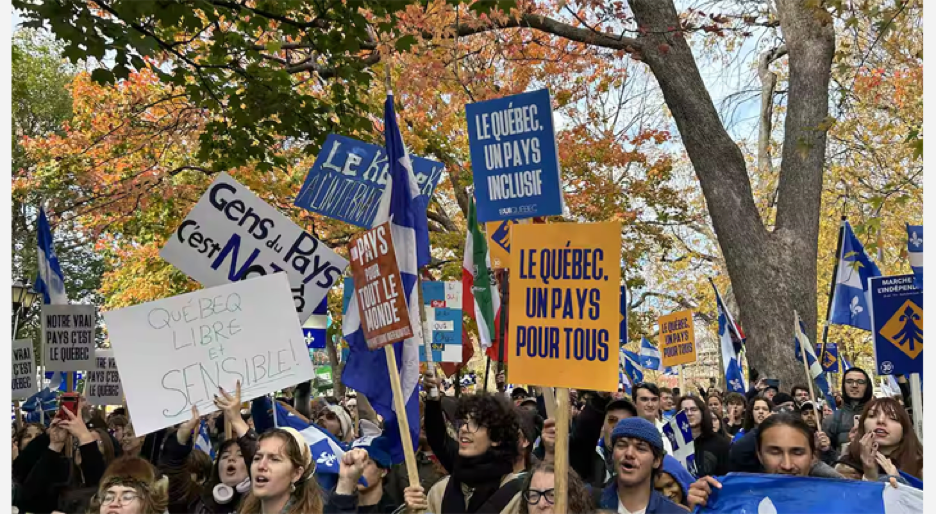
The Quebec sovereignty movement has never been a monolithic bloc. From its inception, it has been riddled with deep tensions that extend beyond electoral strategies, referendum timetables, and partisan alliances to a far more fundamental question: what kind of independence do we want, for whom, and by what means? How do the main actors position themselves in relation to this essential issue? What kind of consultation should be offered to the people of Quebec? How should we assess the current situation surrounding the prospect of fighting for independence?
1. The federalist bloc: managing dependency and denying the self-determination of oppressed nations within the Canadian state
To answer these questions, we must begin with two essential observations. First, the Canadian state was built on national oppression—of the French-Canadian nation, of Indigenous and Inuit peoples, and of the Acadian people. Any questioning of this state will necessarily involve challenging these colonial relationships. Second, Quebec independence implies questioning the integrity of one of the most important imperialist states, an ally of the United States of America. Canadian imperialism will fiercely resist any attempt at Quebec’s separation or the recognition of the self-determination of oppressed nations, not simply because of any particular political figure, but because of the very foundations of this state and its role in the North American imperialist system. The end of this domination can only come about under the pressure of a vast popular movement capable of building active solidarities between the people of Quebec and the labour movement of the rest of Canada and with the Indigenous nations — the latter constituting today forces of resistance to the extractivist and petroleum course of the federal state.
Since the 1995 referendum defeat, the Canadian state has equipped itself with legal instruments to frame and neutralize any desire for Quebec self-determination. Chief among these is the Clarity Act, which grants the federal Parliament the power to determine the very validity of a referendum question and the majority required to recognize its legitimacy. The Carney government continues this tradition: rejecting the 50%+1 principle , unconditionally defending Canadian unity, and demonstrating a clear intention to prioritize fossil fuel and strategic materials development projects over the rights of Quebec and First Nations —thus revealing the profoundly extractivist nature of the federal state.
At the provincial level, the federalist bloc takes two forms. The CAQ claims to defend Quebec’s autonomy within the framework of Canadian federalism, while refusing to confront federal control over key economic levers: currency, major communication channels, immigration policy, international policy, and trade agreements. The Quebec Liberal Party goes even further, advocating for full federalism and mobilizing fear around immediate issues—healthcare, cost of living, housing—to stifle the national question, a tactic proven effective in the two previous referendums. This party is preparing a new campaign designed to attribute Quebec’s economic difficulties to the instability of a potential referendum, thereby consolidating the power dynamics that independence specifically aims to challenge.
2. The Parti Québécois bloc or mitigated sovereignty
On the national stage, the Parti Québécois consistently sought a compromise with Canadian imperialism. The sovereignty-association proposal aimed to strengthen Quebec’s political prerogatives (Quebec’s sovereign power over all its laws and treaties) while maintaining an association with the rest of Canada. This search for accommodation even went through a phase of “beautiful risk” after the 1980 referendum defeat, which consisted of establishing a new mode of Quebec’s integration into the Canadian whole based on relatively minimal demands. The 1995 referendum was held on the basis of sovereignty-partnership, which maintained common confederal institutions .
Since 1995, the Parti Québécois (PQ) has been characterized by a constant postponement of the referendum deadline. Bouchard, Landry, Boisclair, Marois, Lisée—all have balked at holding a referendum, citing the absence of “winning conditions.” This stance has gradually stripped the PQ’s sovereignty project of its urgency and demobilized its base. Paul St-Pierre Plamondon attempted to break with this logic by committing to hold a referendum during his first term. But this commitment runs up against some difficult realities: support for sovereignty has plateaued at just over a third of the population in recent polls, and nearly two-thirds oppose holding a referendum. St-Pierre Plamondon himself has not ruled out waiting until the end of Donald Trump’s term—fueling accusations of backpedaling that are undermining his credibility.
On social issues, the Parti Québécois (PQ) embodies the inherent ambiguity of a tradition that has always oscillated between a progressive popular nationalism and a bourgeois management of Quebec state affairs. Its reformist legacy is real: legislation on the financing of political parties, anti-strikebreaking legislation, automobile insurance and protection of agricultural zoning; pay equity; five-dollar daycare and drug coverage. This legacy long allowed the PQ to link the national project to a concrete improvement in the living conditions of the majority of the population. But it has always coexisted with structural compromises: Lévesque imposed decrees against public sector unions in 1981; Bouchard negotiated a “zero deficit” by cutting public services. Marois’s Charter of Values, presented as a defense of secularism, in practice targeted racialized people and weakened the link between the national movement and immigrant communities.
With PSPP, this oscillation seems to have resolved itself in favor of an identity-based nationalism centered on denouncing the importance of immigration and demanding cultural conformity under the pretext of defending secularism. By systematically linking the housing crisis, difficulties accessing healthcare, and the decline of French to immigration presented as “uncontrolled,” the Parti Québécois leader recycles rhetoric that makes migrants the scapegoats for the contradictions of Quebec capitalism .
The report by OUI Québec , based on consultations with fifty organizations, assesses the damage: 64% of the groups consulted believe that Quebec has regressed on living together with immigrants, 77% call for a comprehensive societal project, and 71% express a strong sense of powerlessness. The document’s most striking statement sums up the issue: “we have replaced pride with isolationism .” Former pillars of the party publicly acknowledge that this discourse is hindering the broadening of the independence movement’s social base, while the most radical identity-based wing, embodied by Mathieu Bock-Côté, responds by labeling these critics “useful idiots of federalism”—thus revealing the depth of the internal divide.
A strategy that marginalizes immigrant workers — who represent a growing share of Quebec’s wage earners, particularly in the health, service and precarious work sectors in agriculture or in the restaurant industry — deprives the national movement of essential social forces and objectively serves the interests of the dominant classes, who have every interest in keeping the working classes divided on the issue of independence.
On the issue of First Nations, the Parti Québécois (PQ) approaches the relationship with calculated caution . Its “Blue Book” on independence includes a chapter on First Nations, while specifying that their consent, although “highly desirable” from a political and moral standpoint, is not legally required. This formulation reveals a conception of Quebec sovereignty that remains centered on the colonial nation-state, seeking Indigenous support without granting a genuine right to self-determination.
3. A left-wing bloc: independence must carry a project of social and national emancipation
Faced with the federalist bloc and the conservative nationalism of the Parti Québécois, Québec Solidaire and the entire independentist social left defend a radically different conception of independence—not as the mere creation of a new state, but as the collective reconquest of power by the popular majority over its resources, its institutions, and its destiny. This conception implies the democratic nationalization (socialization) of strategic sectors of the economy, the ecological planning of production, distribution, and exchange, the guarantee of rights to health, education, and housing, and the enshrining of genuine equality between women and men in the Constitution of an independent Quebec.
On the issue of inclusion, Québec solidaire and the social left explicitly defend an independence project that considers newcomers to Quebec as subjects of the national project and not as a threat to be contained. Ruba Ghazal points out that young people from immigrant backgrounds support an inclusive independence project, but that they too often hear a discourse that gives them “the impression that everything is their fault.”
On Indigenous issues, Québec solidaire proposed Bill 698, co-developed with First Nations, aimed at obtaining their free, prior, and informed consent before any new legislation affecting their communities. This approach was developed through ongoing collaboration with First Nations, demonstrating that it is possible to work as equals. This position stems from a fundamental break with the colonial framework: Quebec independence cannot be built on the denial of the rights and territories of Indigenous peoples, lest it reproduce, on a different scale, the very colonial logic it claims to transcend.
4. The strategic choice: national majority or popular majority?
Two main approaches are vying to build a majority in favor of independence. The first focuses on broad-based unity. This would involve bringing together left- and right-wing pro-independence supporters around the minimal objective of sovereignty, postponing the debate on the societal project until after independence so as not to hinder the formation of a “Yes” camp. The second approach focuses on building a popular majority around an egalitarian, feminist, and anti-racist societal project, making independence the vehicle for profound social transformation.
The first strategy has a long history within the sovereigntist movement: it underlies the logic of convergence that has periodically led left-wing forces to subordinate themselves to the Parti Québécois (PQ) in the name of referendum unity. But it is riddled with contradictions that it cannot resolve. There is no such thing as socially neutral independence. All the concrete questions—what currency, what relations with Ottawa, what labour laws, what place for Indigenous nations, what immigration policy, what wealth distribution, what ecological transition, and so on—immediately reveal profound divergences between the sovereigntist right and left. To try to gloss over these differences is either to produce a project so vague that it fails to mobilize anyone, or to allow one side to silently impose its content on the other. This is, in fact, what has always happened: when the sovereigntist left has converged behind the PQ, it is the PQ’s social and economic platform—and not that of the left—that has defined the project presented to the public.
The demands for social transformation, workers’ rights, and feminist and anti-racist demands should, according to this strategy, be postponed until after independence, which in no way guarantees their realization. Furthermore, a coalition that brings together business leaders hostile to union rights and precarious workers, identity nationalists and newly arrived Quebecers from immigrant backgrounds, does not constitute a social bloc: it is a temporary amalgamation of groups with conflicting interests, which will fall apart as soon as the referendum campaign forces a clarification of the project. Finally, by postponing the debate on the societal project, this strategy deprives independence of what could make it a mobilizing force for the majority of the population: why would a healthcare worker, a tenant crushed by the cost of housing, or a young racialized woman fight for an independence whose social content remains deliberately undefined?
The second strategy starts from the opposite premise: a majority will not be built by stripping independence of its social content, but by giving it a sufficiently strong content so that the popular majority recognizes its own aspirations within it. If support for sovereignty has stagnated for the last thirty years, it is partly because the project has too often been presented as that of a culturally homogeneous nation, managed by a Francophone elite, without the majority of working people, who struggle to find housing, clearly seeing its benefits. Building a popular majority for independence means reversing this logic: showing that independence is an instrument at the service of those who live and work here—whatever their origin—and that national emancipation is inseparable from social emancipation. This fusion of the national and the social was at the heart of the most enduring national liberation movements of the 20th century. In concrete terms, it means linking independence to the right to housing, the defense and expansion of public services, the ecological transition, genuine equality between women and men, and the fight against systemic racism. This program is not a left-wing agenda superimposed on the national question. It is the embodiment of what it truly means to break with the structures of domination perpetuated by the federal order.
This approach is the only one capable of producing a truly broad social bloc—a coalition not of partisan machines but of organized social forces, rooted in real communities and capable of sustained mobilization: the labour movement, feminist organizations, environmental groups, immigrant associations, and Indigenous nations. All these forces have objective reasons to support an independence that clearly promises social transformation in their favour. None has any reason to mobilize for an independence whose social content would remain contingent on a future agreement between political elites with divergent interests. The pro-independence majority that Quebec needs will not emerge from a pact between parties, but from the convergence of social struggles and the national question—through the demonstration, in the daily practice of the movement, that independence is not the project of an ethnic faction or a managerial elite, but rather that of the majority of those who live, work, and fight here.
Québec Solidaire and the entire radical left have an irreplaceable role to play here: not simply to criticize the shortcomings of the PQ from the outside, but to actively build convergences between the national movement, the union movement, Indigenous communities and immigrant communities around a common project — an independent, ecological, social and decolonial Quebec.
5. The referendum must follow the constituent process
Quebec’s referendum history raises a question that the independence movement has never truly resolved: why were two intense campaigns, led by generations of activists, insufficient to convince a majority of the population to vote? The common answer—lack of leadership, unfavorable circumstances, economic fears skillfully cultivated by the federalist camp—is not wrong, but it is inadequate. It overlooks a deeper structural limitation, inherent in the very form of the referendum process as it has been practiced thus far.
The Quebec referendum model, as governed by the Act respecting popular consultations, is based on a fundamentally top-down approach. An elected government alone decides the timing, the question, and the framework of the vote. The population is then called upon to decide, in a few weeks of campaigning, a question formulated without its input and concerning a societal project on which it has not collectively deliberated. This process places the popular majority in the position of passive recipient rather than active participant: it is asked to approve or reject a project it did not help to create.
But political awareness—that is, the profound transformation of a people’s relationship with its own capacity to govern itself—doesn’t happen in a few weeks of televised debates. It requires time, real spaces for deliberation, and a collective experience of power and its possibilities. A referendum campaign can mobilize pre-existing convictions; it cannot, on its own, create new ones. In 1995, the near-victory of the Yes side rested on a surge of emotion in the final weeks of the campaign—a surge that expressed a deep desire for emancipation, but which was shattered by the absence of a sufficiently developed and grassroots-owned social project to withstand the pressure from the No side. The mobilization was real; the grassroots support, insufficient.
The central issue is not simply whether Quebec should be independent, but what kind of independent Quebec we want to build—what institutions will govern it, according to what values, in service of what interests, with what rights guaranteed for which communities. This question cannot be decided by any political party, even a sovereigntist or progressive one. It belongs to the people as a whole and can only be resolved through a long, open, and truly constituent deliberative process.
A constituent assembly is not simply a committee of experts tasked with drafting a constitution. It is a democratic space for collective construction, where elected ordinary citizens—representative of the true diversity of society—debate, negotiate, and decide on the foundations of living together. This process is in itself an act of political emancipation: people cease to see themselves as subjects governed by the decisions of a parliamentary elite and begin to see themselves as the legitimate authors of their own political order. It also creates the space in which progressive social forces can incorporate their demands into the founding project, thus overcoming the recurring dilemma of the sovereignist left—forced to choose between supporting an independence project whose social content remains vague or distancing itself from it at the risk of weakening the Yes camp.
This is also the only way to build a truly new relationship with Indigenous nations. The Indigenous question cannot be resolved after independence, nor can it be left to the goodwill of a sovereignist government. It must be at the heart of the constituent process itself, with the full and complete participation of First Nations in defining the legal and institutional foundations of the new Quebec. A referendum held without this preliminary work would, regardless of its outcome, reproduce the colonial logic of the Canadian state—simply transposed under the Quebec flag.
The sequence is therefore self-evident: the constituent process must precede the referendum. Only once the people of Quebec—in all their diversity—have had the opportunity to debate and collectively build the societal project that will accompany independence will the referendum question regain its full mobilizing power. The vote will then no longer be an abstract answer to a question formulated by a political party; it will be the democratic ratification of a project that the people themselves have developed. The legitimacy of the Yes side will be of a completely different nature—no longer that of an arithmetic majority wrested from the ashes of an emotional campaign, but that of a people who have collectively and deliberately exercised their sovereignty.
The independence movement didn’t lose in 1995 for lack of boldness or mobilization. It lost because the question of the Quebec it wanted to build after the Yes vote remained too vague, too detached from the concrete aspirations of the majority of the people. Learning this lesson means understanding that the next winning referendum won’t be the one held the fastest, but the one that is best prepared—by first letting the people take ownership of the issue themselves.
These strategic directions were largely developed in debates within Québec Solidaire that defined the party’s unique position on the national question. They deserve to be defended against strategies that have not yielded the expected results.
Reprinted from Presse-toi à gauche!, June 2026.