

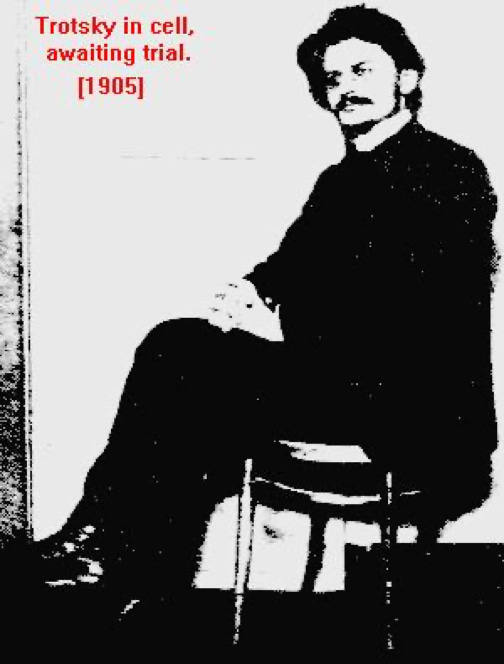
At the age of twenty-six, Leon Trotsky played a leading role in the failed Russian revolution of 1905. While he was in jail awaiting trial, he penned a ninety page article that analyzed the social forces behind the revolution. “Results and Prospects” offered a ground breaking explanation of how a technically backward country such as Russia could produce the most advanced political result - a workers’ revolution for socialism.
This 1906 booklet proved to be one of the most astonishing political breakthroughs in Marxist thinking in the 20th century. By rejecting the idea of separate historical stages - first the bourgeois-democratic one in the future Russian Revolution, he raised the possibility of transforming the democratic into a proletarian/socialist revolution in a permanent (i.e. uninterrupted) process. The Law of Uneven and Combined Development and the theory of the Permanent Revolution contained in this booklet predicted the general strategy of the October revolution in 1917 and provided key insights into other revolutionary processes in China, Indochina, Cuba, etc.
The idea of ‘permanent revolution’ actually appeared in Marx and Engels’ writings in 1850 where they insisted on an independent proletarian perspective in the unfolding German Revolution of 1848-1850: “while the democratic petty bourgeoisie want to bring the revolution to an end as quickly as possible, it is in our interest and our task to make the revolution permanent until all the propertied classes have been driven from their ruling positions, until the proletariat has conquered state power and until the association of the proletarians has progressed sufficiently far- not only in one country but in all the leading countries of the world”.
This passage contains three of the fundamental themes of Trotsky’s Results and Prospects:
1. the uninterrupted development of the revolution in an underdeveloped country leading to the conquest of power by the working class,
2. the need for the proletarian forces in power to take anti-capitalist and socialist measures and,
3. the necessarily international character of the revolutionary process and the new socialist society, without classes or private property.
Dialectics was at the heart of the theory of permanent revolution. Trotsky’s bold views in Results and Prospects were informed by a specific understanding of Marxism, an interpretation of the dialectical materialist method, distinct from the dominant orthodoxy of the Second International, and of Russian Marxism. Examples include the concept of the unity of the opposites, his condemnation of the abstract formalist character of the Mensheviks, his viewpoint of totality - perceiving capitalism and the class struggle as a world process, the interconnectedness of the different parts of totality, his rejection of un-dialectical economism, and his rich and dialectical understanding of historical development as a pre-determined evolution. Trotsky achieved a dialectical synthesis between the universal and the particular, the specificity of Russian social formation and the world capitalist process. The theory of permanent revolution would later become the cornerstone of Trotsky’s fight against Stalin’s fatalistic theory of “socialism in one country”. Trotskyism is often described as simply anti-Stalinism, but Trotskyism’s real content ultimately lies in not what it opposes, but what it puts forward. It is clear that Trotsky’s theory was a brilliant example of applied dialectics in the analysis of new historical circumstances.
Trotsky wrote that “Dialectical training of the mind is as necessary to a revolutionary fighter as finger exercise is to a pianist, it demands approaching all problems as processes and not as motionless categories.” In other words, as with anything, dialectical training of your brain is a fluid process that will be filled with ups and downs. Learning dialectics takes patience and determination, but learning to think dialectically opens your mind to a whole new way of understanding the world.
Almost all economies today are considered capitalist economies. Most would probably agree that all capitalist states would have common characteristics, as well as being subjected to certain laws and tendencies. However, we cannot conclude that capitalist economies are identical or that they develop the same way. This would be a mistake in the form of formalism.
Formalism means taking one’s starting point from general categories and definitions, deducing particular conclusions from these, and then seeking to impose them on the observed fact; an all too common approach in politics today that leads to serious errors. In reality, nothing is ever unchanged, static, and isolated. Everything is interconnected, always in constant process of coming towards and passing away, and turning into the opposite.
Trotsky’s theory of permanent revolution is without a doubt one of the most important theories of Marxism. Understanding what the permanent revolution is and how it develops is crucial for the development of the revolutionary party and for socialist revolution.