

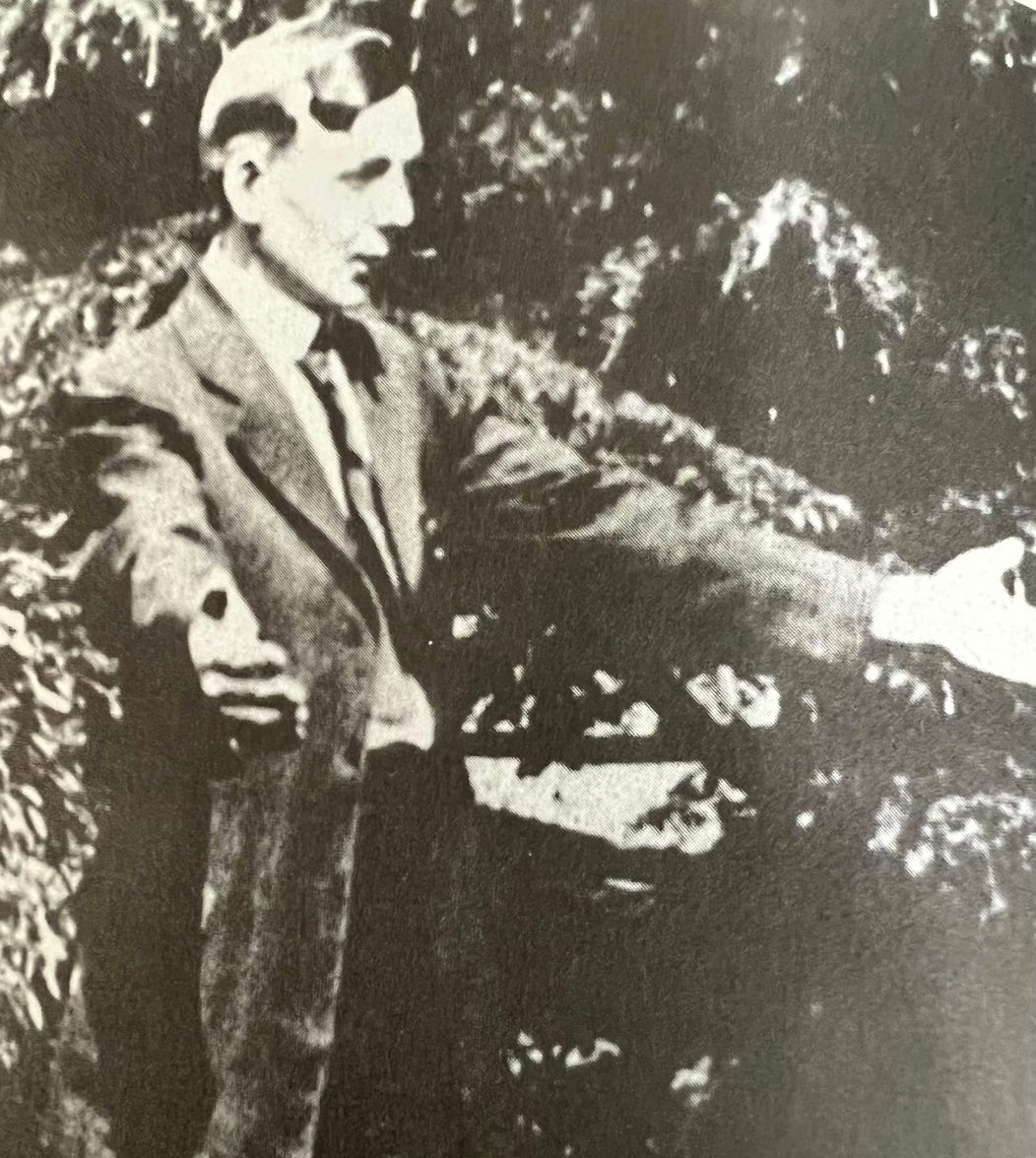
May Day was officially declared a workers’ holiday in 1889. At a Paris congress, an international federation of socialist groups and trade unions designated May 1st for a “great international demonstration” honoring workers. This date was chosen in honour of the workers struggle for the 8-hour day at McCormick Harvester plant in Chicago in 1886 during which police fired on workers killing several. Canadian workers have their own martyrs and this is the story of such a man.
Albert Edgar Goodwin was born on May 10, 1887, in the small mining village of Treeton in Yorkshire, England. He was the son of a coal miner, and his future was etched in stone from the start. The life of a miner in late 19th-century England was one of brutal hardship, defined by long hours, constant danger, and meager pay. At the tender age of 12, Albert followed his father into the pits, his formal education cut short by the family’s economic necessity. Another version of his story says he started in the mines at 15 because his parents wanted him to learn to read and write. It was in these dark, cramped tunnels that he earned his nickname, “Ginger,” a moniker derived from his fiery red hair and, as those who knew him would later attest, an equally fiery temperament.
The mines of Yorkshire were also a fertile ground for the labour movement. Goodwin was exposed early to the ideals of trade unionism and socialism, philosophies that offered an explanation for the poverty and exploitation he witnessed daily. By the time he was a young man, he was not only a skilled miner but also a budding activist, convinced that collective action was the only path to dignity for working people.
The Voyage to Canada
In 1906, at the age of 19, Goodwin joined a wave of British immigrants seeking better opportunities in the vast resource frontiers of Canada. He settled in the mining camps of British Columbia, a province then gripped by the fierce battles between powerful industrialists and an increasingly radicalized workforce. He found work in the smelter city of Trail before eventually gravitating to the coal mines of Vancouver Island, specifically the town of Cumberland.
Cumberland was a company town, owned and operated by Canadian Collieries (Dunsmuir) Ltd. The company controlled not just the jobs, but the housing, the stores, and even the police. Miners lived in a state of economic servitude, paid in company scrip that could only be spent at inflated company stores. It was a system designed for control, and it was in this environment that Goodwin’s activism would fully mature.
Rise to Leadership
Goodwin quickly became a central figure in the labor movement on Vancouver Island. He was a natural organizer: articulate, fearless, and possessed of a quiet charisma that made men trust him. In 1912, he was elected secretary of the newly formed Cumberland Miners’ Union, Local 425 of the United Mine Workers of America (UMWA). The union immediately clashed with Canadian Collieries over wages, safety conditions, and the brutal company store system. The simmering conflict erupted in a massive strike in 1912, “The Great Strike” as it is still known, that lasted over two years.
The strike was ultimately defeated, a common outcome in the era’s labor battles. The consequences for Goodwin were severe. His name was placed on a blacklist—a formal list circulated among employers of “troublemakers” who were to be denied employment. Unable to work in the Cumberland mines, Goodwin was forced to leave the island. He found work in the smelter at Trail, B.C., where he continued his union work, helping to organize the smelter workers and further honing his skills as a labor leader.
When World War I broke out in 1914, Goodwin’s convictions were put to a profound test. A committed socialist, he saw the war as an imperialist conflict that pitted worker against worker for the benefit of the ruling class. He publicly opposed conscription when it was introduced in 1917, arguing that working men were being forced to fight for a system that had always exploited them.
The War, the Strike, and the Fugitive
In 1917, Goodwin managed to return to the Cumberland mines, the blacklist apparently having lapsed due to the wartime labor shortage. He resumed his role as a union leader and immediately began organizing against the policies of Canadian Collieries. On the day he was to report for a military medical examination, he was leading a strike over workplace safety, an act of defiance that infuriated the company and the government.
Shortly thereafter, he was declared “fit for service” by the military. Many of his supporters believed this was a direct reprisal for his union activities, a convenient way to remove a dangerous radical from the community. Goodwin had previously been excused from military service owing to previous injuries and lung problems from working in coal mines. Goodwin refused to be conscripted. Instead of reporting for duty, he packed his belongings and, with the help of fellow miners and local Indigenous people who knew the territory, escaped into the dense, mountainous forests surrounding Comox Lake, just outside Cumberland.
For nearly a year, Goodwin lived as a fugitive. He survived in a makeshift cabin, with supporters secretly bringing him food and supplies. He became a folk hero, known as the “Smiling Man” for his cheerful disposition even in hiding. To the miners and their families, he was a symbol of principled resistance against an alliance of corporate power and state authority that was trying to crush them.
Death and Legacy
On July 27, 1918, a special constable named Dan Campbell, a former miner who had crossed the picket line years earlier, tracked Goodwin to his camp. The only account of what happened next comes from Campbell. He claimed that when he ordered Goodwin to surrender, Goodwin reached for his rifle, forcing Campbell to shoot in self-defense. Goodwin was killed instantly by a single bullet to the heart.
The reaction was immediate and explosive. The miners of Cumberland did not believe Campbell’s story. They saw it as a targeted assassination, a message from the company and its allies that the life of a union man was of no consequence. Campbell was arrested but was swiftly acquitted by a grand jury—a body of prominent local citizens—which further fueled the outrage.
News of Goodwin’s death spread like wildfire through the labor halls of British Columbia. In Vancouver, the Trades and Labour Council called for a one-day general strike on August 2, 1918, to protest the killing and the acquittal. It was the first general strike in Canadian history. Thousands of workers walked off their jobs, shutting down the city’s industry and transportation in a powerful display of solidarity.
Albert “Ginger” Goodwin was 31 years old. He was buried in the Cumberland cemetery, his funeral becoming one of the largest public gatherings in the town’s history. His gravestone, bearing the emblem of the UMWA, stands as a monument not just to one man, but to a pivotal moment in the struggle for workers’ rights in Canada. Though he was killed in the final year of World War I, his legacy as a martyr for the cause of labour endured, a potent symbol of resistance against corporate power and state repression.
In subsequent years, reformists and social democrats tried to portray Goodwin as a pacifist and a reformist. But Goodwin’s writings prove that he was a revolutionary socialist and a man willing to fight for the overthrow of capitalism and the establishment of workers’ power. He was for several years a member of, and in 1916 a candidate for, the Socialist Party of Canada. It was members of the Socialist Party, the One Big Union and the Socialist Labour Party that formed the Communist Party of Canada in 1921, three years after the assassination of Ginger Goodwin.
Here is a sample of Ginger Goodwin’s writings:
“Wherever you go you see the same revolt implanted into the workingmen, and as this thing is gradually increasing why soon things will have to come to a climax.
If we study the condition of the workers it is only logical that this spirit of revolt is existing among them, for wherever we go we see the same miserable conditions and the same competition for jobs in order that they may live.
Now, then, we know that all this misery is the outcome of someone’s carelessness, and that someone is the capitalists, those who own the machinery of production. Now, as this class of parasites have been living on the blood of the working class, they are responsible for the conditions existing at the present time.
… This tool-owning class are the masters of the situation, for in order for you to gain access to the means of life you have to go to an employer and sell yourself. Now, as you go to the boss and say ‘How are chances?’ he will retort in this manner: ‘Come around in a few days and I might have a vacancy.’ He means by this that you will have to wait until he can hire you and make a profit of you.
In order to throw this system over we have got to organize as a class and fight them as class against class.
And so I say we have got to back our forces against them, and our weapons are education, organization and agitation, and read and study up on the principles of Socialism, for it is necessary that you know when to strike and how to strike, and if we have not these weapons when the time comes, we shall not be able to predict the outcome of the fight.
All I know is this, that in every phase of society, whenever a change took place, it was the outcome of force which determined the winning side, so what we want is to educate you to your power, Mr. Workingman, and when we realize it we have the power and the lever to overthrow the existing society.”
-From Ginger Goodwin’s article “The Iron Heel”